Jess Del Rio

Sacred Medicines

A critical atlas of the plants & molecules
of consciousness

Breathe in Breathe out
Breathe with the orb — 6 s · 6 s
Discover the book
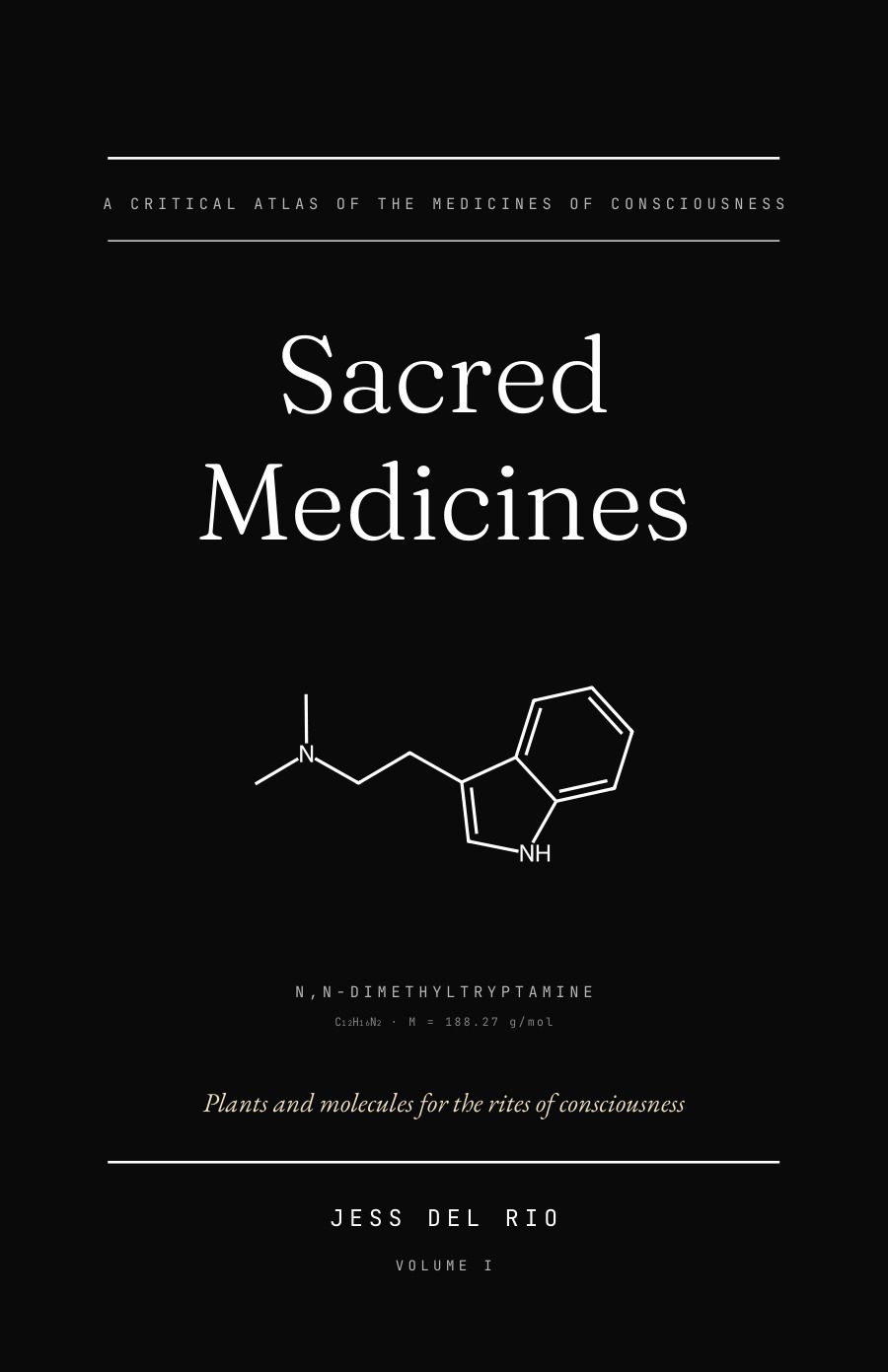
Sacred Medicines — Volume I cover

A companion for those who seek — and for those who accompany

This book is neither a manual of consumption nor an apologia. It is an atlas — in the cartographic sense of the word — of a territory where botany, pharmacology, anthropology, medicine, and law rarely overlap with the rigor that each of these disciplines demands on its own. Between the demonization inherited from the war on drugs and New Age mystification, tens of millions of people use these substances today — in ritual, clinical, therapeutic, or exploratory contexts — without any serious, accessible frame of reference.

The ambition is twofold: to document what the sciences describe — pharmacology, neuroscience, clinical trials, interactions, risk profiles — and what the traditions transmit — history, cosmovisions, ritual structures, lineages of use. Twenty-six monographs under a uniform grid, an opening part that lays the foundation, and an appendix “Legality — in 2026” that takes stock, country by country.

For the seeker For the guide Anthropological stance Ontological pluralism
Order on Amazon

Twenty-six monographs in eight families

An ethnobotanical and pharmacological atlas organized by pharmacological and cultural families — history, pharmacology, cosmovision, law.

Opening part — Before the medicines
  • ·Before the substances: the paths without psychotropics
  • ·Understanding the molecules: families, mechanisms, and precautions
  • ·The container: what separates a medicine from a trauma
  • ·On the right use of guides: power, transference, and abuses
  • ·Distinguish, know, respect
I
Visionary tryptamines
  • 01DMT N,N-dimethyltryptamine
  • 02Ayahuasca Banisteriopsis caapi + Psychotria viridis
  • 03Jurema Mimosa tenuiflora · hostilis
  • 04Harmala & β-carbolines Peganum harmala
  • 055-MeO-DMT 5-methoxy-N,N-dimethyltryptamine
  • 06Bufotenin 5-HO-DMT
  • 07Acacia Acacia confusa, A. obtusifolia
II
Amphibian medicines
  • 08Toad secretions Bufo alvarius · Incilius alvarius
  • 09Kambô Phyllomedusa bicolor
  • 10Jaguar synthetic 5-MeO-DMT
III
Amazonian master plants
  • 11Tobacco Nicotiana rustica · N. tabacum
  • 12Rapé · Hapé Nicotiana + ritual ashes
  • 13Sananga Tabernaemontana undulata · T. sananho
IV
Iboga complex
  • 14Iboga Tabernanthe iboga
  • 15Ibogaine isolated alkaloid
V
Phenethylamines & cacti
  • 16Mescaline 3,4,5-trimethoxyphenethylamine
  • 17Peyote Lophophora williamsii
  • 18San Pedro · Huachuma Echinopsis pachanoi · peruviana
  • 19MDMA entactogen
VI
Sacred mushrooms
  • 20Psilocybes Psilocybe spp.
  • 21Fly agaric Amanita muscaria
VII
Lysergics & plant atypicals
  • 22LSD lysergic acid diethylamide
  • 23LSA lysergic acid amide · ergine
  • 24Salvia Salvia divinorum
VIII
Methylxanthines & sacred foods
  • 25Caffeine methylxanthine stimulant
  • 26Cacao & Chocolate Theobroma cacao

A few lines from the book

“The plant does not give us an experience. It restores us to what we had forgotten we knew.”

Author’s note

“Substances are a lever, not a doorway.”

Opening part

“In the traditions that carry these plants, one does not “take” them: one “works” with them — and one also says that they work us.”

Epilogue — The threshold of the work

“Ignorance — whether prohibitionist or enthusiastic — does more damage than shared knowledge.”

Preface — Why this book

Interactive companions

Four free interactive modules, extensions of the atlas.

Jess Del Rio

Jess Del Rio

Jess divides his life between his family, his travels, his profession in information security, and his practice as a therapist. He lives between Belgium and France, travels regularly in search of encounters with the medicines, and often joins his friends in the Brazilian cerrado.

It all began in 2011: since then he has devoted part of his time to discovering and studying the sacred medicines, in their traditional as well as contemporary contexts, with particular attention to Brazilian practices, to jurema, and to the Amazonian medicines encountered along the way. The door remains open to other initiatory and therapeutic medicines.

On the accompaniment side, he is certified by several schools of hypnosis — including the American Hypnosis Association (AHA), in the United States — and practices EMDR as well as patient support.

His dual stance — documentary rigor and grounding in practice — refines and affirms writing as a method for sharing knowledge. Trained in permaculture and agroforestry since 2005, he approaches the sacred plants as living beings rather than as molecules.

FAQ

Why this book?
For myself, above all — and that may be the best reason to write one. A few years ago, I began compiling notes and discoveries in a text file. Over time, the file grew, the branches multiplied, and it became clear that to truly master these subjects, you have to dig and sort with rigor. This book is the written trace of that process: consolidating knowledge I thought I had, testing it against the act of writing, organizing it so it holds up. If other readers get something out of it, all the better. The genesis, though, is personal.
Who is this book written for?
For two kinds of readers I call A and B — who mirror each other throughout the book. Reader A is living, or considering, an experience with the psychedelic medicines. Reader B accompanies, or wishes to. Each chapter is built so that both readings coexist, with neither taking priority. If you find yourself in both at once, that is by design.
It reads like an encyclopedia...
Yes, I know. It is the natural result of how I work: in a tree structure, in a fairly square-edged way. This book does not tell stories — it is neither a travel narrative nor a spiritual testimony. It is more a guide that lifts the curtain to reveal the machinery of the sacred medicines: the mechanisms, the frameworks, the therapeutic aims. The reader looking for narrative will pass it by. The one who wants to understand how it works, why, and within what container — will find plenty to read.
How does it differ from other books on the subject?
By its central axis: the therapeutic aim being sought, not the substance or the tradition. Most books on the subject are organized around a molecule or a practice. Here, the entry point is different: what is one trying to traverse, transform, integrate? Each chapter then crosses four frames of analysis — Western clinical, Amazonian shamanism, neo-Western circle, solo or dyadic practice — without ranking any of them.
Does this book encourage the use of substances?
No. The stance is strictly descriptive and anthropological. This book prescribes no practice, recommends no substance, and is no substitute for medical or therapeutic care. It documents and analyzes existing practices in their contexts — clinical, traditional, contemporary — with the same rigor and the same distance.
Are the approaches presented legal?
The legal status of these practices varies from country to country and changes quickly — sometimes from one year to the next. The book contextualizes the relevant regulatory frameworks where possible, but this information is indicative. It is up to each reader to verify the legislation in force in their own country before taking any step.
What is the difference between Volume I and Volume II?
Volume I (Plants and molecules for the rites of consciousness) lays the foundations: substances, mechanisms, therapeutic frameworks, aims. It is the cartography. Volume II (Change... is here and now) goes down into the concrete: rites of consciousness, therapies, ceremonies, integration. Less cartography, more terrain. The two volumes are independent but complementary. Volume II is being written, with publication planned for late 2026.
Was AI used in the writing?
Yes and no. It is 2026 — AI is part of my skill set, just like documentary research. I use it for spell-checking, source verification, and sometimes to break out of a frame when a line of thought goes in circles. A precious tool. Never the substance. The editorial choices, the structure, the angle, the positions — that is me. The one steering the work is me.
Where can I order the book?
Volume I is available in paperback on Amazon — see the “Order on Amazon” button above. The contact form below is also there for any question, or to be notified of upcoming releases.
Write to the author

For any question about the book, a press inquiry, or an editorial accompaniment project.

Send an email

sacredmedicinesbooks@gmail.com